Home » Pension 101 » Survivor benefits
Survivor Benefits
Choosing a beneficiary
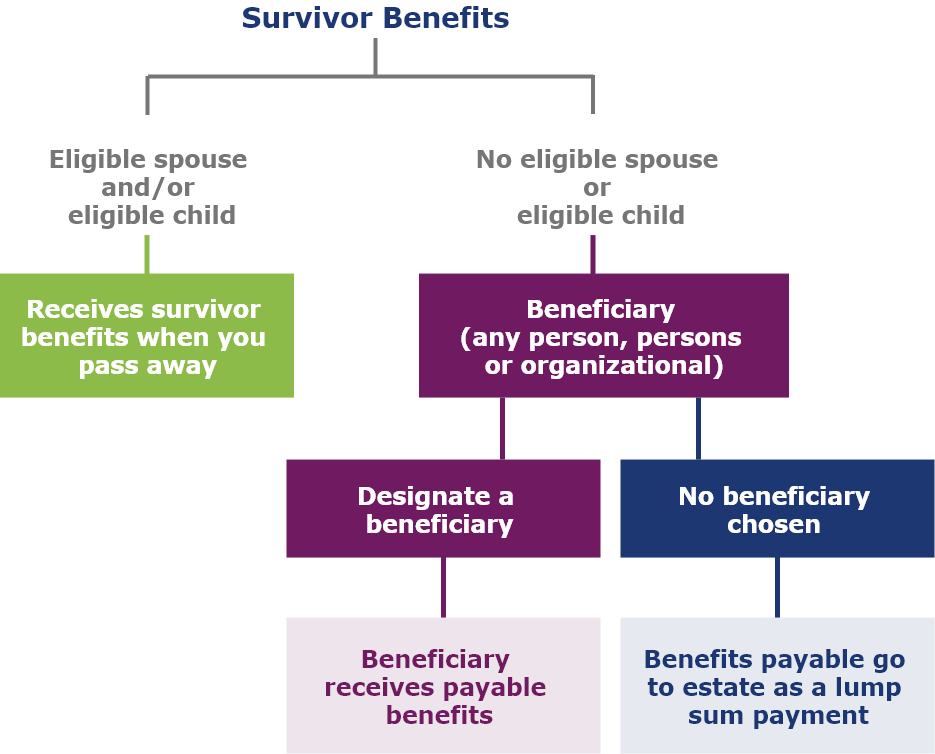
If you don’t have an eligible spouse or eligible children, your beneficiary may be entitled to receive survivor benefits. A beneficiary can be any person, persons, or organization you choose. If you don’t choose a beneficiary(s), or your beneficiary(s) passes away before you, any benefits payable when you pass away will go to your estate as a lump-sum payment (less applicable withholding taxes).
What's on this page
- How survivor benefits can help
- Commonly asked questions
- Keep reading: Pension 101
Beneficiary scenarios
Commonly asked questions
Your beneficiary can be one or more people or a corporation, such as a charity. You should name a beneficiary and review your designation whenever your personal circumstances change, such as having a baby or getting married. By law, your eligible spouse is entitled to receive survivor benefits when you pass away.
You can review and change your spousal declaration and beneficiary designation on My Pension Resource by completing the form.
- married to each other; or
- not married to each other but are living together in a conjugal relationship, either: continuously for a period of not less than three years; or
- in a relationship of some permanence, if they are the parents of a child, as set out in section 4 of the Children’s Law Reform Act pursuant to subsection 1 (1) of the Pensions Benefit Act.
- under age 18; or
- 18 or older but less than 25 and attending full-time, continuous education; or
- 18 or older and suffers from a physical or mental disability that has prevented them from earning a living since reaching 18 or since your passing, whichever occurred most recently.
Your child is eligible for survivor benefits if they’re 18 or older and have a physical or mental disability that has prevented them from earning a living since reaching 18 or since your passing, whichever occurred most recently. It’s important to inform us if you have an eligible dependent to ensure they receive their entitlement under the Plan, should you pass away.
You will need to provide the following documentation to ensure your dependent is eligible for survivor benefits:
- a recent copy of the Ontario Disability Support Program statement that shows your dependent is receiving a disability benefit from the Government
- a medical report or letter provided by a qualified doctor or nurse practitioner (it should include when your dependent’s disability began)
- a copy of a long form birth certificate
- a copy of the Power of Attorney for property or guardian document for property, if the Eligible Child is over the age of 18 and unable to manage his or her own property
Contact the WISE Trust Pension Contact Centre for more information on how to provide this documentation. Eligibility of a person designated as an Eligible Child with a disability to survivor benefits from the Plan is required to be assessed at the date of the member’s death.
- you didn’t have an eligible spouse on your retirement date; or
- you did have an eligible spouse on your retirement date, and they’ve passed away and you have no eligible children entitled to survivor benefits.
Spousal waiver of pre-retirement survivor benefits
Under Ontario pension law, if you pass away before retirement and you have an eligible spouse, your spouse is typically considered the primary recipient for survivor benefits payable by your WISE Trust pension. However, your spouse may waive their right to these benefits at any time before you pass away.
We recommend that you and your eligible spouse obtain independent legal advice before signing any waiver to a pension benefit entitlement.
If your eligible spouse chooses to waive these benefits and you die before your pension begins, any survivor benefits payable would be paid to your designated beneficiary. If you don’t designate a beneficiary, these benefits will be payable to your estate. Your eligible spouse can also cancel the waiver at any time, prior to your passing. After you pass away, the waiver cannot be changed.
Spousal waiver of joint and survivor pension
Under Ontario pension law, if you pass away after retirement and you have an eligible spouse, your spouse is typically considered the primary recipient for survivor pension payable by WISE Trust. However, there may be situations where your eligible spouse may want to waive their right to this benefit.
We recommend that you and your eligible spouse obtain independent legal advice before signing any waiver to a pension benefit entitlement.
To waive their right, your eligible spouse must submit a waiver during the 12-month period before your retirement. This waiver cannot be cancelled once you start collecting your pension.
If your eligible spouse submits a waiver, survivor benefits will be paid to any eligible children you have. If you don’t have eligible children, the excess, if any, of your contributions plus interest made to WISE Trust, less any pension payments you received will be paid to your designated beneficiary or estate.