Home » Retirement » How your pension is calculated
How your pension is calculated
Estimating your pension
You can estimate your pension on My Pension Resource. Simply select a specific retirement date, age, or your unreduced, reduced, or normal retirement date and get a pension estimate. You can compare up to 3 estimates to see what date works best for you.
What's on this page
- Retirement dates and monthly payments
- Retirement age
The pension formula
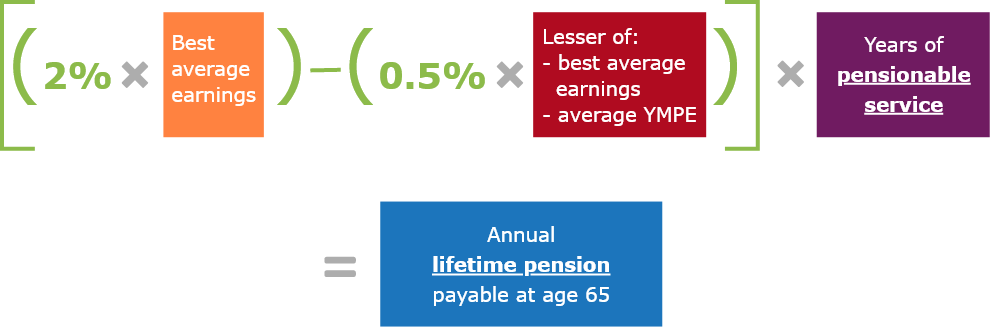
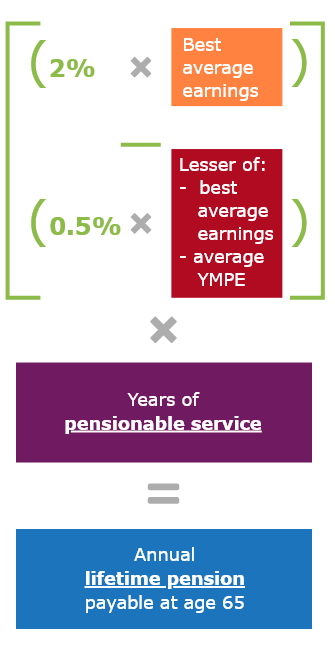
Understanding the pension formula
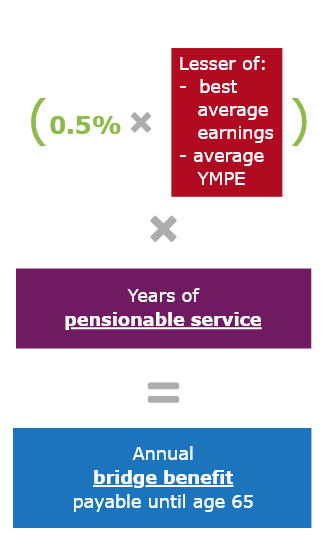
Your best average earnings is based on highest average of your annualized pensionable earnings over any consecutive 60 months, during your last 120 months of pensionable service before your termination, retirement or passing. If you have less than 60 months in the Plan, your best average earnings will be based on your number of months of pensionable service. In general, the higher your average earnings, the higher your pension will be. Your best average earnings does not include:
- overtime pay
- irregular-hour premiums
- performance bonuses
- job differential pay
- second-language bonuses
- pay in lieu of vacation or Management Compensation Option
- any payment in lieu of a benefit provided by your participating employer
Your average year’s maximum pensionable earnings (average YMPE) is the average of the YMPEs during the same averaging period as your best average earnings.
Your years of pensionable service is the total time that you contributed to the Plan, or that the employer contributed on your behalf. It includes any service you transferred in or that you might’ve purchased.
Unreduced early retirement
You can retire without any reduction to your lifetime pension if you qualify under any one of the early retirement rules outlined in Collecting My Pension.
An example of how an early unreduced pension is calculated
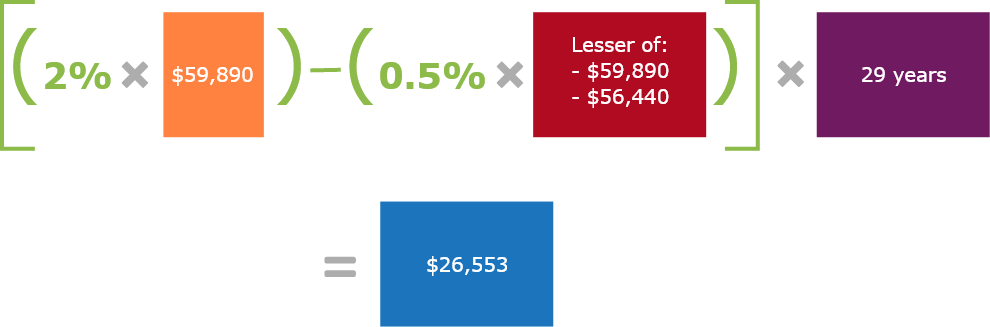
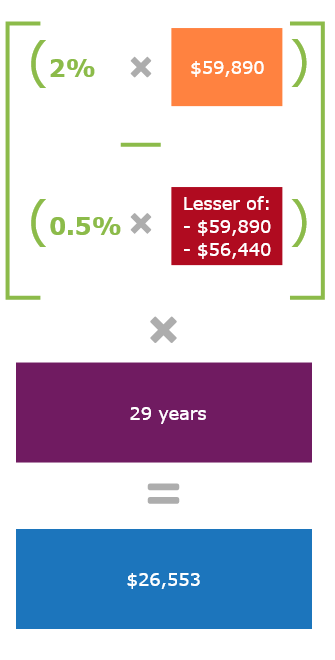
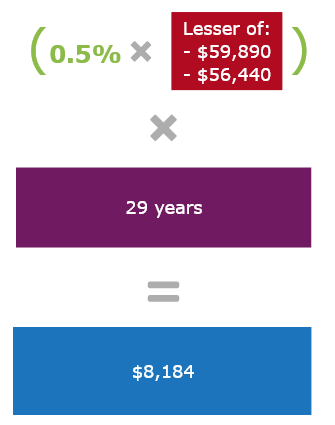
Erin retires in 2021. Her age plus years of membership or pensionable service equals 85. This entitles Erin to an unreduced lifetime pension.
Age: 56
Years of pensionable service: 29
Best average earnings: $59,890
Average YMPE: $56,440
Erin’s annual unreduced lifetime pension is:
Erin's bridge benefit is:
Because Erin is retiring before age 65, she is also entitled to the annual bridge benefit, until she turns 65:

Reduced early retirement
If you do not qualify for an unreduced early retirement, you can still retire early if you are age 55 or older. Your lifetime pension will be reduced to reflect the fact that you’re starting your pension earlier and will probably receive it for a longer period of time.
The reduction is three per cent for each year (or 0.25 per cent for each month) that you retire prior to the date you would have qualified for an unreduced early retirement, or turned age 65 – whichever occurs first. Your monthly bridge benefit does not have an early retirement reduction.
How your pension is calculated when you retire before age 65
What is a bridge benefit?
The bridge benefit acts as a “top up” until you can receive your full CPP entitlement at age 65. However, you can take your CPP before you turn 65 and still receive your bridge benefit.
The bridge benefit is calculated in a similar way to your lifetime pension:
Bridge benefit formula

An example of how the bridge benefit works.
Stella is turning 65 but has been retired for 10 years now
Because she retired before age 65, the Plan has paid her a lifetime pension plus a bridge benefit – until today. The bridge benefit helps level her income until age 65 – when she can collect an unreduced pension from the CPP.
Stella receives her pension cheque in the mail
Once you turn 65, your lifetime pension continues for the rest of your life but the bridge benefit is no longer paid. Even though you can start receiving a reduced CPP pension at age 60, when paying the bridge benefit, the Plan assumes everyone starts collecting their CPP pension at age 65.
Stella has received an envelope marked “OAS”
At age 65 you may also be entitled to a retirement benefit from Old Age Security (OAS). Your WISE Trust pension is not integrated with OAS and those payments are separate from the Plan and CPP entitlements. OAS starts at age 65 and can’t be taken earlier. If you start OAS at 65, this does not impact your Plan benefit in any way.
So, Stella receives a monthly bridge benefit in addition to her lifetime pension under the Plan until she turns age 65, the age when she can begin receiving CPP and, if she qualifies, OAS. Stella’s CPP does not start automatically and will not be equal to the amount of the bridge benefit.
You can learn more about CPP and OAS by contacting Service Canada.